Peptides have become increasingly popular, making them hard to ignore—especially on social media, where influencers frequently discuss their potential benefits. If you’re naturally curious, you’ve probably wondered what peptides are, how they work, and whether they truly live up to the claims.
These are the same questions I hear regularly from my patients: Why are peptides gaining attention now? Are peptides new to medicine? Do they actually work? Are they a cure-all? With so much mixed information online, it’s easy to feel overwhelmed or unsure about what’s fact versus hype.
If you’ve landed on this page, you’re likely looking for clear, evidence-informed answers. You’re in the right place. Here, we’ll explore what peptides are, their role in the body, how they’re used in medicine, and what current research really shows—grounded in science, not trends.
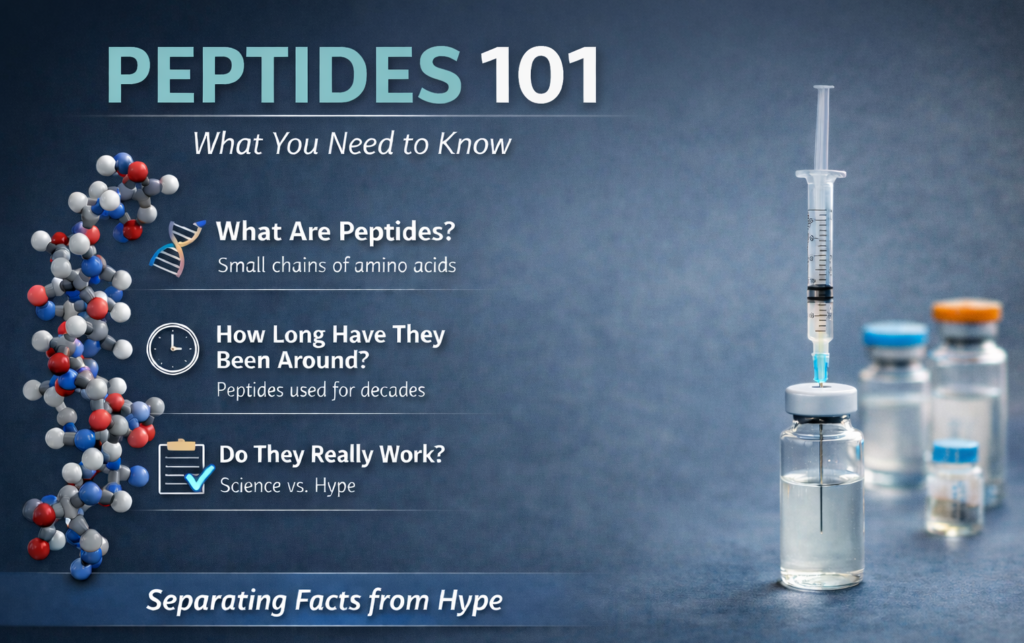
What Are Peptides?
Peptides are small chains of amino acids designed to carry out specific functions in the body. Amino acids are the building blocks of proteins, and peptides are essentially shorter versions of these protein chains.
Our bodies naturally produce peptides; however, peptide production declines with age, which may affect how efficiently certain biological processes function over time.
One of the reasons peptides have gained attention in wellness and medical research is their versatility and receptor specificity. Many peptides are designed to bind to specific receptors, which helps reduce off-target effects and contributes to their potential effectiveness when studied or used appropriately.
A helpful way to understand peptides is through an analogy often shared in science education:
Amino acids are like letters of the alphabet. Peptides are words formed from those letters. Proteins, which are made from longer chains of amino acids, are like full sentences that carry out complex instructions in the body.
Proteins play a critical role in the body. They are essential for building and maintaining muscle, bone, skin, and connective tissue, supporting cellular growth and repair, and forming enzymes, hormones, and antibodies that are vital for metabolism, communication, and immune function.
Understanding how peptides relate to proteins helps explain why they are being explored in research related to health, aging, and wellness.
How Long Have Peptides Been Around?
You may be surprised to learn that peptides are not new to medicine at all. One of the most well-known and widely used peptides is insulin—a medication most people don’t typically think of as a peptide. Insulin is a peptide hormone that has been used to treat diabetes since 1922. Its long history alone shows that peptide-based therapies have been part of modern medicine for over a century.
Beyond insulin, many other peptides have been studied and developed for decades. For example, BPC-157, a peptide originally isolated from human gastric juice, was first identified in 1993. Research into its potential roles in tissue repair and gut health has been ongoing for years.
So if peptides aren’t new, why do they suddenly seem everywhere?
The recent surge in interest is largely due to increased public awareness and the rise of peptide-based medications used for metabolic health and weight management—such as GLP-1 receptor agonists, including semaglutide (Ozempic®), GLP-2 (GIP and GLP-1) including Tirzepatide (Mounjaro). These medications have brought peptides into mainstream conversation, especially on social media.
In reality, peptides have been quietly studied, refined, and used in medical and research settings for decades. What’s new isn’t their existence—but the expanding research, broader applications, and increased public visibility.
Do Peptides Actually Work? Are They a Cure-All?
With the rapid rise in global interest, many people are wondering whether peptides are the solution to every medical problem we face today. Social media influencers often present peptides as a miracle fix—implying they are the key to weight loss, longevity, recovery, and overall health. This has understandably created both excitement and confusion.
To be clear: peptides do work—but they are not a cure-all.
Some peptides have demonstrated strong clinical effectiveness and are supported by robust human data. Others have shown promising results in early studies or animal models but lack sufficient high-quality human trials to fully support widespread clinical use.
For example, peptides used in metabolic health, such as GLP-1 and dual GIP/GLP-1 receptor agonists, have shown significant, reproducible benefits in obesity and metabolic disease and are backed by large randomized controlled trials. These peptides represent one of the strongest success stories in modern peptide-based medicine.
In regenerative and sports medicine, peptides such as BPC-157 have shown encouraging results in preclinical studies related to tissue repair, recovery, and endurance. However, it is important to note that much of the available data comes from animal models or small experimental studies. While these findings are promising, there is currently a lack of large-scale, long-term human randomized controlled trials and meta-analyses to definitively confirm efficacy and safety.
As of 2025, more than 100 peptide-based therapies have been approved globally, with over 200 additional peptides in various stages of clinical trials. That said, a significant portion of published peptide research—estimated at over 50%—still relies on animal studies, which do not always translate directly to human outcomes.
Peptides are also gaining traction in oncology and vaccine development, particularly in the area of personalized cancer vaccines. Early-phase clinical trials have shown promising signals in certain difficult-to-treat cancers, highlighting the expanding role of peptides in precision medicine.
However, when it comes to longevity and wellness claims, popular peptides such as BPC-157 or CJC-1295 currently lack long-term human randomized controlled trials. As a result, many anti-aging or longevity claims remain scientifically unproven at this time.
This does not mean peptides are ineffective. In fact, both clinically and personally, I have observed meaningful benefits with certain peptides when used appropriately and responsibly. The key takeaway is this: peptides are powerful tools—not magic solutions. Their effectiveness depends on the specific peptide, the condition being treated, the quality of evidence supporting it, and appropriate clinical oversight.
Understanding where science ends and speculation begins is essential—and that’s exactly what this platform aims to help you do.
Key Takeaway
Peptides are naturally occurring amino acid chains that play essential roles in how the body functions and heals. While they are not new to medicine, recent advances and high-profile peptide-based medications have fueled renewed interest and public excitement. Some peptides are well-studied and proven to work, while others are still being researched. The key is separating evidence-based use from social media hype and understanding that peptides can support health—but they are not a universal cure.
Conclusion
Peptides have been used in medicine for many years; therefore, they are not a new discovery. The amount of attention they receive and the expanding body of research supporting them have changed. While some peptides are currently being investigated, others have been well researched and supported by data. They can promote health and wellness when taken appropriately, but they are not a panacea. The secret is to be informed, distinguish between science and hype, and make deliberate decisions.
References
López-Ojeda, W., & Hurley, R. A. (2025). New trends in peptide therapies: Perspectives and implications for clinical neurosciences. The Journal of Neuropsychiatry and Clinical Neurosciences, 37(2), A6–101. https://doi.org/10.1176/appi.neuropsych.20240253
Sharma, D., Dhiman, I., Das, S., Das, D., Pramanik, D., Dash, S., & Pramanik, A. (2025). Recent advances in therapeutic peptides: Innovations and applications in treating infections and diseases. ACS Omega, 10(17), 17087–17107. https://doi.org/10.1021/acsomega.5c02077